
MARKETHINK RESEARCH LEDGER
AI Marketing Statistics 2026
A selective collection of 60 AI marketing statistics from 9 original sources. Every number keeps its source, date, population, definition, and limitation close enough to check.

THREE SOURCE-LED VIEWS
Different populations. Different questions. No false comparison.
These charts stay within each study’s denominator. The accompanying tables repeat every value.
CHART 01
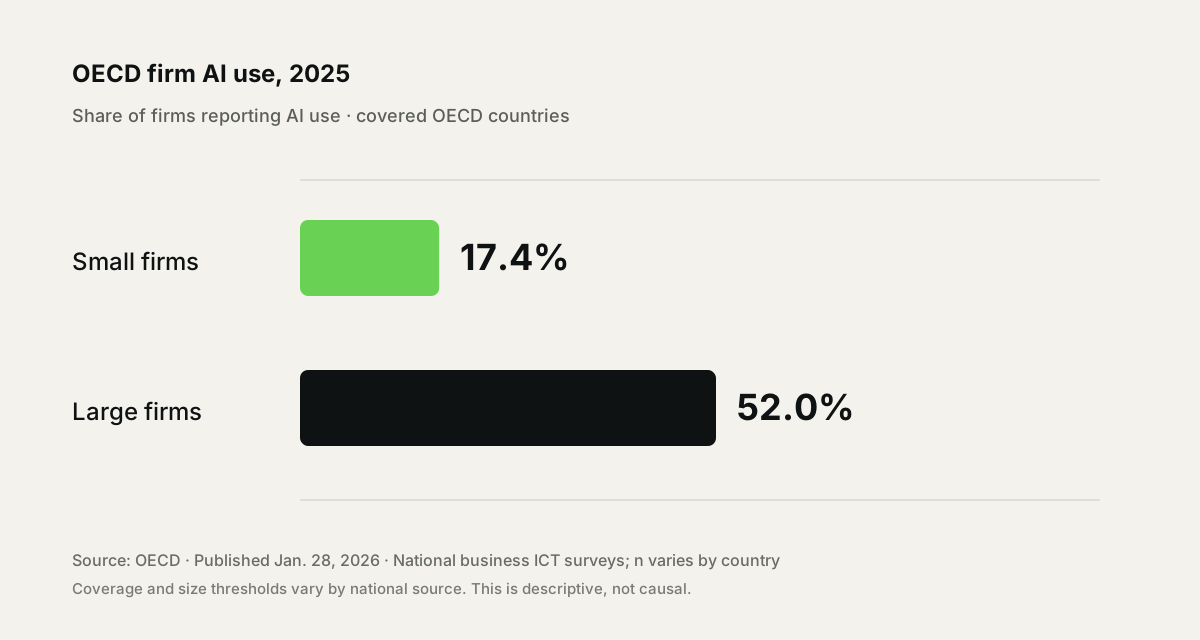
Large firms reported AI use at nearly three times the small-firm rate.
| Population | Share reporting AI use |
|---|---|
| Small firms | 17.4% |
| Large firms | 52.0% |
CHART 02
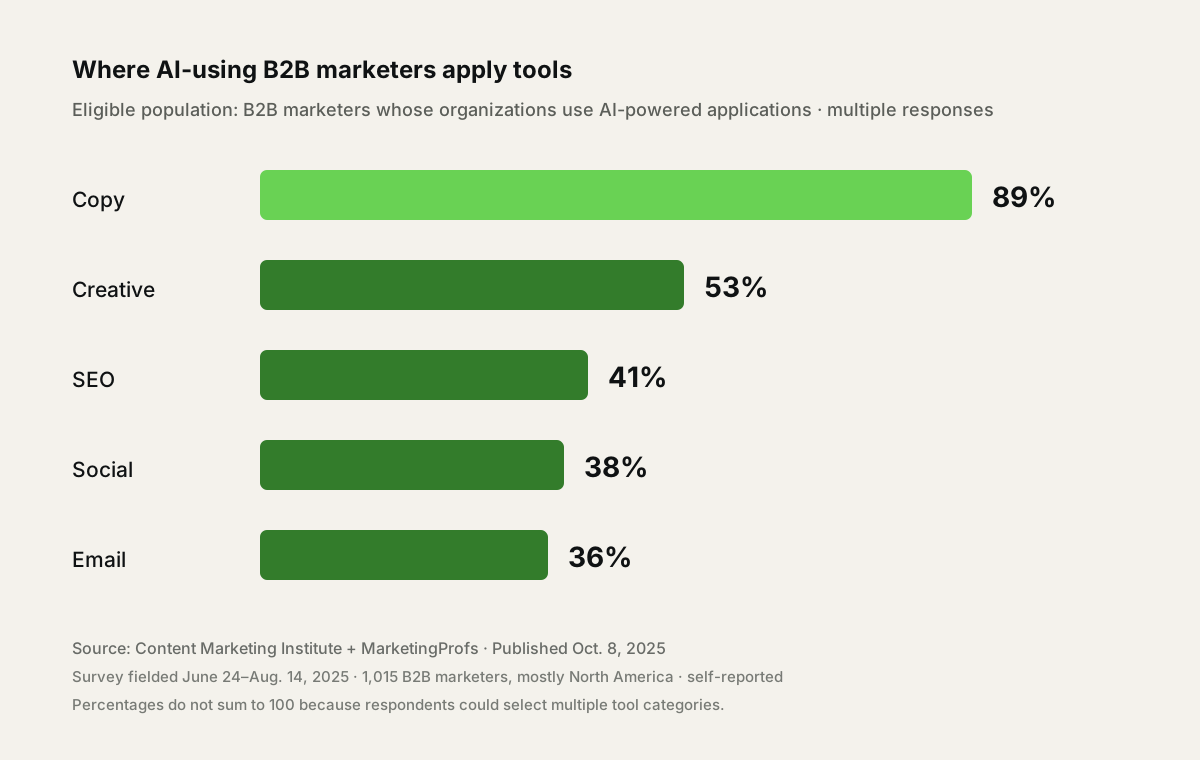
Copy leads AI tool use among AI-using B2B marketers.
| Tool category | Share selecting category |
|---|---|
| Copy | 89% |
| Creative assets | 53% |
| SEO | 41% |
| Social media | 38% |
| Email marketing | 36% |
CHART 03
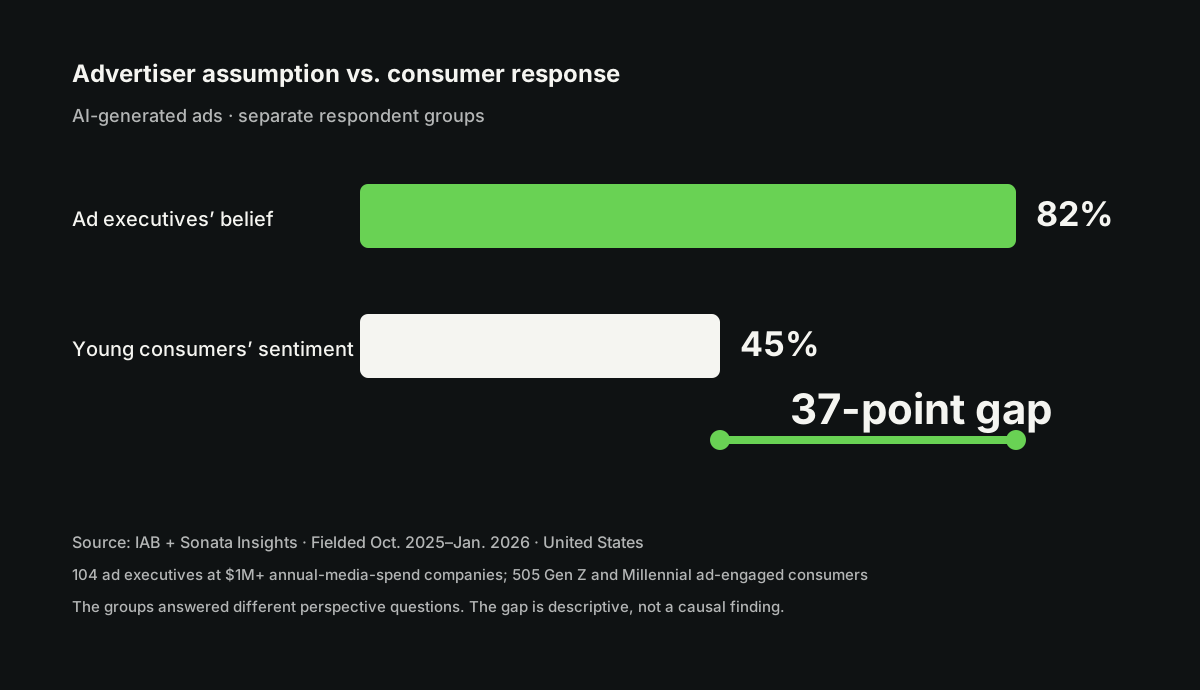
Advertisers overestimated young consumers’ positive sentiment by 37 points.
| Respondent group | Positive sentiment measure |
|---|---|
| Ad executives’ belief about consumers | 82% |
| Surveyed Gen Z and Millennial consumers | 45% |
FOUR NUMBERS TO START WITH
The useful story is adoption plus operating discipline.
17.4%Small firms across covered OECD countries that reported using AI in 2025.
95%B2B marketers saying their organizations use AI-powered applications.
37-point gapAd executives who believed young consumers felt positive about AI-generated ads, compared with the share of surveyed consumers who actually reported positive sentiment.
One-thirdRespondents saying their organizations were scaling AI programs across the organization.
MARKETHINK ANALYSIS
What this evidence can support.
Adoption is not one number.
Firm-level surveys, marketing-team surveys, and vendor studies count different behaviors. Treat the definition as part of the statistic.
Broad use can coexist with shallow deployment.
High “any use” figures sit beside lower organization-wide deployment figures. Experimentation is not the same as an embedded operating system.
Content is common. Measurement is less mature.
Writing and creative tools lead use cases, while measurement frameworks and causal outcome evidence remain limited.
Trust depends on visible human controls.
In one global survey, organizations ranked clear AI disclosure and easy escalation to human support among the most important trust factors. These results describe stated priorities, not proof that either control produces trust.
01 / 09
Adoption is broad. Deployment is not the same thing.
These figures use different units: firms, employees, marketing teams, pilots, and organization-wide deployment. Read the scope before comparing percentages.
US firms that used AI in a business function during the supplement reference period.
Study context and limits
- Evidence
- self-reported adoption
- Study
- United States; November 2025 to January 2026
- Limitation
- Firm adoption, employment-weighted adoption, and worker task use are different measures. The survey does not isolate marketing departments.
US firm AI use on an employment-weighted basis during the same period.
Study context and limits
- Evidence
- self-reported adoption
- Study
- United States; November 2025 to January 2026
- Limitation
- Employment weighting answers a different question from the 18% firm-level estimate by giving more influence to larger employers.
US firms expected to use AI in a business function within six months.
Study context and limits
- Evidence
- projection
- Study
- United States; November 2025 to January 2026
- Limitation
- This is a stated expectation, not observed future adoption.
AI-using firms that integrated AI into three or fewer business functions.
Study context and limits
- Evidence
- self-reported adoption
- Study
- United States; November 2025 to January 2026
- Limitation
- Firm adoption, employment-weighted adoption, and worker task use are different measures. The survey does not isolate marketing departments.
US firms reporting that workers used AI in work-related tasks.
Study context and limits
- Evidence
- self-reported adoption
- Study
- United States; November 2025 to January 2026
- Limitation
- Firm adoption, employment-weighted adoption, and worker task use are different measures. The survey does not isolate marketing departments.
Firms across OECD countries with available data that reported using AI in 2025.
Study context and limits
- Evidence
- self-reported adoption
- Study
- OECD countries where data were available; 2025
- Limitation
- Coverage is limited to countries with available data. Definitions and business-size thresholds can vary by national source.
B2B marketers describing their organizations as exploratory or developing in AI implementation.
Study context and limits
- Evidence
- self-reported adoption
- Study
- Global, mostly North America; June 24 to August 14, 2025
- Limitation
- This combines the report's 20% exploratory and 48% developing categories.
Organizations that had embedded agentic AI organization-wide for customer support.
Study context and limits
- Evidence
- scaled deployment
- Study
- North America, Latin America, Europe, APAC and the Middle East; October to November 2025
- Limitation
- Business results are self-reported by executives and CX practitioners at organizations with at least $250 million in revenue. Customer results are a separate sample.
Organizations that had embedded agentic AI organization-wide for brand discovery and search.
Study context and limits
- Evidence
- scaled deployment
- Study
- North America, Latin America, Europe, APAC and the Middle East; October to November 2025
- Limitation
- Business results are self-reported by executives and CX practitioners at organizations with at least $250 million in revenue. Customer results are a separate sample.
US ad executives saying their company had deployed AI in the creative process.
Study context and limits
- Evidence
- self-reported adoption
- Study
- United States; October 2025 to January 2026
- Limitation
- The executive sample is small and limited to companies spending at least $1 million annually on media. Consumer findings cover Gen Z and Millennials only.
Respondents saying their organizations regularly used AI in at least one business function.
Study context and limits
- Evidence
- self-reported adoption
- Study
- 105 nations; June 25 to July 29, 2025
- Limitation
- Results are self-reported and weighted by national GDP. Organization-wide AI use is broader than marketing use.
Respondents saying their organizations were scaling an agentic AI system somewhere in the enterprise.
Study context and limits
- Evidence
- scaled deployment
- Study
- 105 nations; June 25 to July 29, 2025
- Limitation
- Results are self-reported and weighted by national GDP. Organization-wide AI use is broader than marketing use.
Respondents saying their organizations had begun experimenting with AI agents.
Study context and limits
- Evidence
- experimentation
- Study
- 105 nations; June 25 to July 29, 2025
- Limitation
- Results are self-reported and weighted by national GDP. Organization-wide AI use is broader than marketing use.
Respondents saying their organizations were scaling AI programs across the organization.
Study context and limits
- Evidence
- scaled deployment
- Study
- 105 nations; June 25 to July 29, 2025
- Limitation
- The report describes this as roughly one-third and shows larger companies scaling more often.
02 / 09
Small-business use depends on what the survey counts.
A survey asking about any business AI use can produce a very different number from one asking about AI in marketing. Both can be accurate within their definitions.
Small firms across covered OECD countries that reported using AI in 2025.
Study context and limits
- Evidence
- self-reported adoption
- Study
- OECD countries where data were available; 2025
- Limitation
- Coverage is limited to countries with available data. Definitions and business-size thresholds can vary by national source.
Large firms across covered OECD countries that reported using AI in 2025.
Study context and limits
- Evidence
- self-reported adoption
- Study
- OECD countries where data were available; 2025
- Limitation
- This is a size comparison, not evidence that firm size alone causes adoption.
US small-business owners who said they currently use AI technologies for business activity.
Study context and limits
- Evidence
- self-reported adoption
- Study
- United States; 2025; exact field dates not stated in the report text
- Limitation
- The sample is drawn from NFIB members, and several AI-use findings apply only to the smaller subset of current users.
Nonusers who said they did not plan to use AI for business purposes in the next 12 months.
Study context and limits
- Evidence
- stated intention
- Study
- United States; 2025; exact field dates not stated in the report text
- Limitation
- The base is respondents not currently using AI, n=385 for the table containing this question.
Among current small-business AI users, 27% reported using or planning to use AI for marketing or advertising.
Study context and limits
- Evidence
- self-reported use or plan
- Study
- United States; 2025; exact field dates not stated in the report text
- Limitation
- The question asked current AI-using employers which areas they were using or planning to use AI. Multiple responses were allowed; n=118.
US SMB respondents reported as adopting AI in marketing by April 2026, up from 26% in 2023.
Study context and limits
- Evidence
- self-reported adoption
- Study
- United States, United Kingdom, Canada, Australia and New Zealand; Q2 2026; US adoption figure measured by April 2026
- Limitation
- The release does not publish the full question wording. The broad marketing adoption measure should not be compared directly with NFIB current business use.
03 / 09
Marketing is a leading business use case.
The strongest evidence points to active use across sales and marketing, but the maturity of that use varies from experimentation to embedded workflows.
AI-using firms that deployed AI in sales and marketing, the most common function reported.
Study context and limits
- Evidence
- self-reported adoption
- Study
- United States; November 2025 to January 2026
- Limitation
- Firm adoption, employment-weighted adoption, and worker task use are different measures. The survey does not isolate marketing departments.
B2B marketers saying their organizations use AI-powered applications.
Study context and limits
- Evidence
- self-reported adoption
- Study
- Global, mostly North America; June 24 to August 14, 2025
- Limitation
- Results are self-reported. The research was sponsored by a marketing technology company, and the B2B sample was mostly North American.
Marketing teams saying they use AI in at least a few marketing areas.
Study context and limits
- Evidence
- self-reported adoption
- Study
- Global; Not stated on the public report page
- Limitation
- Results are self-reported, and the public page does not disclose detailed sampling or field dates. Extensive and occasional use are separate response categories.
04 / 09
Content is the entry point. Campaign operations are wider.
Copy and creative production lead current usage. Social, SEO, email, and advertising workflows show where AI is moving beyond a single drafting tool.
Task-level AI adopters reporting generative AI use for writing and editing.
Study context and limits
- Evidence
- self-reported adoption
- Study
- United States; November 2025 to January 2026
- Limitation
- The base is firms reporting task-level adoption, not all firms.
Among current small-business AI users, 29% reported using or planning to use AI for communications.
Study context and limits
- Evidence
- self-reported use or plan
- Study
- United States; 2025; exact field dates not stated in the report text
- Limitation
- The question asked current AI-using employers which areas they were using or planning to use AI. Multiple responses were allowed; n=118.
AI-using B2B marketers using content tools to generate or optimize copy.
Study context and limits
- Evidence
- self-reported adoption
- Study
- Global, mostly North America; June 24 to August 14, 2025
- Limitation
- Results are self-reported. The research was sponsored by a marketing technology company, and the B2B sample was mostly North American.
AI-using B2B marketers using tools to generate or edit creative assets.
Study context and limits
- Evidence
- self-reported adoption
- Study
- Global, mostly North America; June 24 to August 14, 2025
- Limitation
- Results are self-reported. The research was sponsored by a marketing technology company, and the B2B sample was mostly North American.
AI-using B2B marketers using AI-powered SEO tools.
Study context and limits
- Evidence
- self-reported adoption
- Study
- Global, mostly North America; June 24 to August 14, 2025
- Limitation
- Results are self-reported. The research was sponsored by a marketing technology company, and the B2B sample was mostly North American.
AI-using B2B marketers using AI-powered social media tools.
Study context and limits
- Evidence
- self-reported adoption
- Study
- Global, mostly North America; June 24 to August 14, 2025
- Limitation
- Results are self-reported. The research was sponsored by a marketing technology company, and the B2B sample was mostly North American.
Ad executives whose companies used AI for social-media ads.
Study context and limits
- Evidence
- self-reported adoption
- Study
- United States; October 2025 to January 2026
- Limitation
- The executive sample is small and limited to companies spending at least $1 million annually on media. Consumer findings cover Gen Z and Millennials only.
Ad executives whose companies used AI for display ads.
Study context and limits
- Evidence
- self-reported adoption
- Study
- United States; October 2025 to January 2026
- Limitation
- The executive sample is small and limited to companies spending at least $1 million annually on media. Consumer findings cover Gen Z and Millennials only.
Marketers using AI extensively or occasionally for content creation, respectively.
Study context and limits
- Evidence
- self-reported adoption
- Study
- Global; Not stated on the public report page
- Limitation
- The two values are separate response categories and should not be presented as a single 80.5% estimate without the full questionnaire.
Marketers using AI extensively or occasionally for advertising automation and optimization, respectively.
Study context and limits
- Evidence
- self-reported adoption
- Study
- Global; Not stated on the public report page
- Limitation
- The two values are separate response categories and should not be presented as a single 70.6% estimate without the full questionnaire.
05 / 09
Lead and follow-up evidence needs careful attribution.
Survey respondents report improved lead generation and growing use in email. These are useful operating signals, not proof that AI caused the outcome.
AI-using B2B marketers using AI-powered email marketing tools.
Study context and limits
- Evidence
- self-reported adoption
- Study
- Global, mostly North America; June 24 to August 14, 2025
- Limitation
- Results are self-reported. The research was sponsored by a marketing technology company, and the B2B sample was mostly North American.
Organizations reporting that lead generation performance somewhat or significantly improved over the prior three years.
Study context and limits
- Evidence
- self-reported outcome
- Study
- North America, Latin America, Europe, APAC and the Middle East; October to November 2025
- Limitation
- Business results are self-reported by executives and CX practitioners at organizations with at least $250 million in revenue. Customer results are a separate sample.
06 / 09
Human review remains part of the operating model.
Respondents consistently point to augmentation, disclosure, and escalation to people. This is evidence about preferred controls and working models, not a universal rule for every task.
Firms experiencing AI-related task effects that used AI only to augment tasks.
Study context and limits
- Evidence
- observed operating model
- Study
- United States; November 2025 to January 2026
- Limitation
- Firm adoption, employment-weighted adoption, and worker task use are different measures. The survey does not isolate marketing departments.
Current small-business AI users reporting no change in employee count.
Study context and limits
- Evidence
- self-reported outcome
- Study
- United States; 2025; exact field dates not stated in the report text
- Limitation
- The employment table has n=119. This does not predict future workforce effects.
Organizations ranking clear disclosure of AI interactions among the most important factors for building trust in agentic AI.
Study context and limits
- Evidence
- organizational priority
- Study
- North America, Latin America, Europe, APAC and the Middle East; October to November 2025
- Limitation
- Business results are self-reported by executives and CX practitioners at organizations with at least $250 million in revenue. Customer results are a separate sample.
Organizations ranking easy escalation to human support among the most important trust factors for agentic AI.
Study context and limits
- Evidence
- organizational priority
- Study
- North America, Latin America, Europe, APAC and the Middle East; October to November 2025
- Limitation
- Business results are self-reported by executives and CX practitioners at organizations with at least $250 million in revenue. Customer results are a separate sample.
Marketers who saw AI working with marketers and assisting with most job duties.
Study context and limits
- Evidence
- respondent opinion
- Study
- Global; Not stated on the public report page
- Limitation
- Results are self-reported, and the public page does not disclose detailed sampling or field dates. Extensive and occasional use are separate response categories.
Marketers who believed more unique, human-centered content is needed to compete with AI content.
Study context and limits
- Evidence
- respondent opinion
- Study
- Global; Not stated on the public report page
- Limitation
- Results are self-reported, and the public page does not disclose detailed sampling or field dates. Extensive and occasional use are separate response categories.
07 / 09
Investment is moving toward AI, with scrutiny attached.
The available budget figure records stated 2026 priorities. It should not be read as realized spend or return on investment.
B2B marketers who put AI-powered marketing tools among their top three areas for increased 2026 investment.
Study context and limits
- Evidence
- stated investment plan
- Study
- Global, mostly North America; June 24 to August 14, 2025
- Limitation
- Results are self-reported. The research was sponsored by a marketing technology company, and the B2B sample was mostly North American.
08 / 09
Trust, governance, and measurement are still unresolved.
Consumers and advertisers do not always see AI-generated marketing the same way. Disclosure, measurement frameworks, and content quality remain material constraints.
Consumers globally who wanted businesses to explicitly label AI-generated content.
Study context and limits
- Evidence
- consumer preference
- Study
- United States, United Kingdom, Canada, Australia and New Zealand; Q2 2026; US adoption figure measured by April 2026
- Limitation
- The publisher sells marketing technology. The release uses a broad SMB marketing AI adoption measure that is not directly comparable with the NFIB business-use question.
SMBs globally reported as fully transparent about their AI use.
Study context and limits
- Evidence
- self-reported practice
- Study
- United States, United Kingdom, Canada, Australia and New Zealand; Q2 2026; US adoption figure measured by April 2026
- Limitation
- The publisher sells marketing technology. The release uses a broad SMB marketing AI adoption measure that is not directly comparable with the NFIB business-use question.
B2B marketers reporting that content quality decreased with AI.
Study context and limits
- Evidence
- self-reported outcome
- Study
- Global, mostly North America; June 24 to August 14, 2025
- Limitation
- Results are self-reported. The research was sponsored by a marketing technology company, and the B2B sample was mostly North American.
Customers who said they would disengage after discovering content was AI-generated.
Study context and limits
- Evidence
- consumer stated response
- Study
- North America, Latin America, Europe, APAC and the Middle East; October to November 2025
- Limitation
- Business results are self-reported by executives and CX practitioners at organizations with at least $250 million in revenue. Customer results are a separate sample.
Customers who said they would disengage after learning they were interacting with AI when expecting a person.
Study context and limits
- Evidence
- consumer stated response
- Study
- North America, Latin America, Europe, APAC and the Middle East; October to November 2025
- Limitation
- Business results are self-reported by executives and CX practitioners at organizations with at least $250 million in revenue. Customer results are a separate sample.
Organizations with a measurement framework implemented for generative AI.
Study context and limits
- Evidence
- observed governance practice
- Study
- North America, Latin America, Europe, APAC and the Middle East; October to November 2025
- Limitation
- Business results are self-reported by executives and CX practitioners at organizations with at least $250 million in revenue. Customer results are a separate sample.
Ad executives who believed young consumers felt positive about AI-generated ads, compared with the share of surveyed consumers who actually reported positive sentiment.
Study context and limits
- Evidence
- perception gap
- Study
- United States; October 2025 to January 2026
- Limitation
- This is a 37-point perception gap across two survey groups, not a causal result.
Gen Z consumers reporting negative sentiment toward AI-generated ads, compared with Millennials.
Study context and limits
- Evidence
- consumer sentiment
- Study
- United States; October 2025 to January 2026
- Limitation
- The executive sample is small and limited to companies spending at least $1 million annually on media. Consumer findings cover Gen Z and Millennials only.
Gen Z and Millennial consumers saying AI disclosure would increase or make no difference to purchase likelihood.
Study context and limits
- Evidence
- stated purchase response
- Study
- United States; October 2025 to January 2026
- Limitation
- This combines two response categories and does not mean disclosure increases purchases for 73%.
09 / 09
Most outcome data is self-reported, not causal.
Productivity, quality, personalization, lead, and retention findings describe what respondents observed. They do not isolate AI from strategy, staffing, channels, or market conditions.
AI-using firms reporting AI-related employment decreases.
Study context and limits
- Evidence
- observed outcome
- Study
- United States; November 2025 to January 2026
- Limitation
- The report also cautions against causal interpretation of its regression evidence.
Current small-business AI users reporting increased productivity.
Study context and limits
- Evidence
- self-reported outcome
- Study
- United States; 2025; exact field dates not stated in the report text
- Limitation
- The impact table has n=110 and does not establish causation.
Current small-business AI users reporting improved product or service quality.
Study context and limits
- Evidence
- self-reported outcome
- Study
- United States; 2025; exact field dates not stated in the report text
- Limitation
- The impact table has n=110 and does not establish causation.
Current small-business AI users reporting lower operating costs.
Study context and limits
- Evidence
- self-reported outcome
- Study
- United States; 2025; exact field dates not stated in the report text
- Limitation
- The impact table has n=110 and does not establish causation.
SMB AI users globally naming time savings as the primary benefit.
Study context and limits
- Evidence
- self-reported outcome
- Study
- United States, United Kingdom, Canada, Australia and New Zealand; Q2 2026; US adoption figure measured by April 2026
- Limitation
- The publisher sells marketing technology. The release uses a broad SMB marketing AI adoption measure that is not directly comparable with the NFIB business-use question.
B2B marketers reporting improved operational efficiency from AI.
Study context and limits
- Evidence
- self-reported outcome
- Study
- Global, mostly North America; June 24 to August 14, 2025
- Limitation
- Results are self-reported. The research was sponsored by a marketing technology company, and the B2B sample was mostly North American.
B2B marketers reporting improved content quality from AI.
Study context and limits
- Evidence
- self-reported outcome
- Study
- Global, mostly North America; June 24 to August 14, 2025
- Limitation
- Results are self-reported. The research was sponsored by a marketing technology company, and the B2B sample was mostly North American.
Organizations reporting that personalization performance somewhat or significantly improved over the prior three years.
Study context and limits
- Evidence
- self-reported outcome
- Study
- North America, Latin America, Europe, APAC and the Middle East; October to November 2025
- Limitation
- Business results are self-reported by executives and CX practitioners at organizations with at least $250 million in revenue. Customer results are a separate sample.
Organizations reporting that customer retention performance somewhat or significantly improved over the prior three years.
Study context and limits
- Evidence
- self-reported outcome
- Study
- North America, Latin America, Europe, APAC and the Middle East; October to November 2025
- Limitation
- Business results are self-reported by executives and CX practitioners at organizations with at least $250 million in revenue. Customer results are a separate sample.
HOW THIS RESOURCE WAS BUILT
Methodology and limitations
Inclusion and verification standards
Inclusion standard
We included a number only when it appeared in an original government dataset, official research report, original survey, or the publisher’s own report page. Secondary statistics roundups were not used as evidence.
Verification standard
Each source URL was loaded during the September 12, 2026 review. Every displayed number maps to a ledger ID, publisher, research period, geography, sample note, evidence type, and limitation.
Claims, curator role, and known limits
What the page does not claim
Self-reported improvement does not prove causation. Stated plans are not realized adoption. Opinions and preferences are not measured business outcomes. Unlike survey questions are not averaged together.
Curator role
Markethink is the curator and analyst, not the original source of third-party statistics. Our analysis is labeled and kept separate from source findings.
- Definitions of AI, generative AI, and agentic AI vary by study.
- Several sources are vendor-sponsored or vendor-published and rely on self-reported responses.
- Global surveys do not automatically represent every country or small business.
- Some subgroup findings use much smaller samples than the headline survey.
- This page is a dated evidence review, not a live market counter.
MACHINE-READABLE
Audit the dataset yourself.
The downloads contain all 60 rows and their research context.
PRIMARY SOURCE INDEX
Nine original sources, with their boundaries.
- S1
The Microstructure of AI Diffusion: Evidence from Firms, Business Functions, and Worker Tasks
U.S. Census Bureau, Center for Economic Studies · 2026-04 · United States
Research period, sample, and limitation
- Research period
- November 2025 to January 2026
- Sample
- Nationally representative Business Trends and Outlook Survey AI supplement; exact n not stated on the summary page
- Source type
- Government statistical working paper
- Limitation
- Firm adoption, employment-weighted adoption, and worker task use are different measures. The survey does not isolate marketing departments.
- S2
AI use by individuals surges across the OECD as adoption by firms continues to expand
OECD · 2026-01-28 · OECD countries where data were available
Research period, sample, and limitation
- Research period
- 2025
- Sample
- National business ICT surveys compiled in the OECD ICT Access and Usage Database; n varies by country
- Source type
- Official intergovernmental statistics
- Limitation
- Coverage is limited to countries with available data. Definitions and business-size thresholds can vary by national source.
- S3
Small Business and Technology 2025
NFIB Research Center · 2025-06 · United States
Research period, sample, and limitation
- Research period
- 2025; exact field dates not stated in the report text
- Sample
- 521 employer responses overall; AI-use questions use smaller bases, including n=118, n=119, and n=110
- Source type
- Original small-business association survey
- Limitation
- The sample is drawn from NFIB members, and several AI-use findings apply only to the smaller subset of current users.
- S4
The Rise of the SMB Creator: Q2 2026 Small Business Now report findings
Constant Contact · 2026-06-10 · United States, United Kingdom, Canada, Australia and New Zealand
Research period, sample, and limitation
- Research period
- Q2 2026; US adoption figure measured by April 2026
- Sample
- 3,340 SMB respondents and 2,255 consumer respondents
- Source type
- Original vendor-commissioned SMB and consumer survey
- Limitation
- The publisher sells marketing technology. The release uses a broad SMB marketing AI adoption measure that is not directly comparable with the NFIB business-use question.
- S5
B2B Content and Marketing Trends: Insights for 2026
Content Marketing Institute and MarketingProfs · 2025-10 · Global, mostly North America
Research period, sample, and limitation
- Research period
- June 24 to August 14, 2025
- Sample
- 1,015 B2B marketers from 1,229 global responses
- Source type
- Original industry survey
- Limitation
- Results are self-reported. The research was sponsored by a marketing technology company, and the B2B sample was mostly North American.
- S6
Adobe 2026 AI and Digital Trends Report
Adobe and Oxford Economics · 2026; exact day not stated on the main report page · North America, Latin America, Europe, APAC and the Middle East
Research period, sample, and limitation
- Research period
- October to November 2025
- Sample
- 3,000 executives and CX practitioners plus 4,000 customers
- Source type
- Original global business and consumer survey
- Limitation
- Business results are self-reported by executives and CX practitioners at organizations with at least $250 million in revenue. Customer results are a separate sample.
- S7
The AI Ad Gap Widens
IAB and Sonata Insights · 2026; exact day not stated on the report page · United States
Research period, sample, and limitation
- Research period
- October 2025 to January 2026
- Sample
- 505 Gen Z and Millennial consumers plus 104 ad industry executives
- Source type
- Original advertising industry and consumer survey
- Limitation
- The executive sample is small and limited to companies spending at least $1 million annually on media. Consumer findings cover Gen Z and Millennials only.
- S8
The state of AI in 2025: Agents, innovation, and transformation
McKinsey & Company, QuantumBlack · 2025-11 · 105 nations
Research period, sample, and limitation
- Research period
- June 25 to July 29, 2025
- Sample
- 1,993 survey participants
- Source type
- Original global executive and practitioner survey
- Limitation
- Results are self-reported and weighted by national GDP. Organization-wide AI use is broader than marketing use.
- S9
2026 State of Marketing
HubSpot · 2026; exact day not stated on the report page · Global
Research period, sample, and limitation
- Research period
- Not stated on the public report page
- Sample
- More than 1,500 B2B and B2C marketers
- Source type
- Original vendor marketing survey
- Limitation
- Results are self-reported, and the public page does not disclose detailed sampling or field dates. Extensive and occasional use are separate response categories.
DEFINITIONS
Glossary
- AI adoption
- A respondent reports using an AI technology. This can range from one task to organization-wide use.
- Experimentation or pilot
- Limited testing that has not necessarily reached standard workflows or broad deployment.
- Scaled deployment
- Use expanded across a function or organization. Each source’s exact definition still applies.
- Generative AI
- Systems that create text, images, audio, video, or other outputs from prompts or data.
- Self-reported use
- Use described by a survey respondent. It is not independently observed behavior.
- Self-reported outcome
- An improvement or decline described by a respondent, without experimental proof that AI caused it.
UPDATE LOG
What changed in this edition.
Initial research edition prepared with 60 verified statistics from 9 original sources. The review records the evidence available on that date and will change only when the research changes.
APPLY THE RESEARCH
Map the evidence to your marketing operation.
Request a focused walkthrough of the workflows, controls, and measurement gaps that matter for your business.
Tell us what you are working on. We will reply with available times.